
Transport and logistics
Scanners that keep reading, terminals that stay connected and support that is awake when your night shift is. We look after the IT chain from the warehouse floor to the planning desk, across the Netherlands and Belgium.
In logistics, the clock keeps running whether IT works or not
A lorry at the gate does not wait for a scanner to reconnect. Every minute of downtime moves straight into the next shift.
Logistics IT sits close to the physical process. A handheld that loses its connection halfway down an aisle, a dock terminal that will not print a document or a planning system that cannot reach the depot: none of it is an abstract problem. It shows up immediately as a queue at the loading bay and as calls from customers asking where their consignment is.
At the same time, a logistics environment is harder to run than an ordinary office network. Coverage has to hold up between full racking and moving stock, in cold stores, on the yard and in the mezzanine. Drivers work from vehicles and mobile devices. Planners depend on links between warehouse management, transport management and the systems your customers use. Those layers are often supplied by different parties, so an outage turns into a search for whoever is going to pick it up.
We take on that chain as a whole. Warehouse Wi-Fi, depot connectivity, the devices on the floor, the links to your planning systems and the service desk your team calls, under one agreement and with service levels that are the same at every site.
Six components, separately or as one logistics environment
You can take individual components. Most operators choose the combination, because the gain lies in removing the handovers between suppliers.
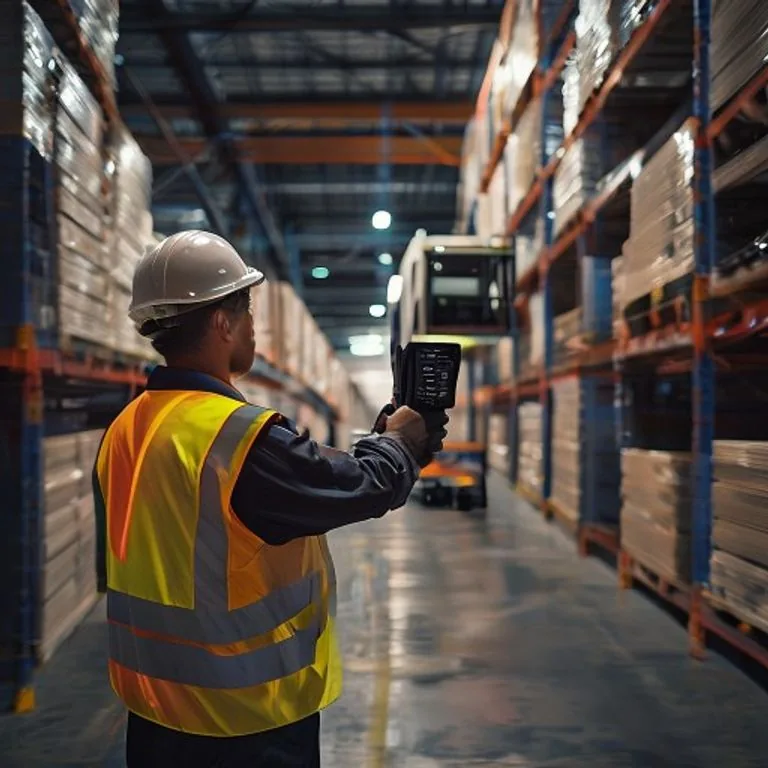
Warehouse Wi-Fi that holds
A site survey measures how your network behaves with the racking full, not with the hall empty. We map coverage, interference and roaming behaviour across aisles, cold stores, the yard and the dock, then design the access point layout around the routes your people and trucks actually take. After the roll-out we keep measuring, because stock levels and layouts change.
Connectivity per site
SD-WAN or broadband VPN for every depot, with redundant uplinks where downtime is not an option. Cabling, switching and monitoring are included, so a new cross-dock is online on the day it opens.
Service desk around the clock
Your warehouse staff, drivers and planners reach our team directly, with no intermediate layer. Nights and weekends are covered by our own shift, and your fixed point of contact sits in the Benelux.
Scanners and terminals
Roll-out, configuration and management of handhelds, vehicle-mounted terminals and label printers, including spare units on site.
Planning systems connected
Links between warehouse management, transport management and customer portals, so orders, stock and status messages stay in step.
Security and access
Access control on the yard, camera set-ups and secure remote access for drivers and subcontractors, arranged in line with the GDPR.
What you can expect from our team
Logistics IT calls for engineers who are comfortable on a warehouse floor and for agreements that read the same at every depot.
- Cover on your night and weekend shiftsNights and weekends are staffed by our own people, so the quiet hours in the planning office are not quiet hours in support.
- Our own engineers in the Netherlands and BelgiumOn-site work we carry out ourselves, without subcontracting and without the mark-up that comes with it.
- Measuring instead of guessingCoverage problems are settled with a survey and figures, not with an extra access point in the hope that it helps.
- Standardised service levelsEvery depot gets the same processes and the same agreements, including sites on both sides of the border.
- Certified way of workingISO 9001, ISO/IEC 27001, ISO 14001 and Kiwa NEN 4400-1, so quality, security and administration are demonstrably in order.
- Experience since 2019More than 150 clients across the Benelux and beyond, built up by founders Enes Bagci and Tunahan Gider.
Staffing, cloud and advisory work are available too. Call 085 060 9347 or email [email protected] to talk through what makes sense in your situation.
How we work in a running operation
A warehouse cannot be switched off for a project. These four principles are standard in the way we work with logistics operators.
Measure the site first
We start with a survey of the hall, the yard and the offices: coverage, interference, cabling and the state of the devices in use. That gives a picture of what is genuinely failing, rather than what people suspect.
Work around the shift plan
Changes go in outside your peak windows and maintenance is scheduled in the quietest slot the operation has.
Solve remotely first
The person reporting an issue is usually an operator with a pallet truck, not an IT specialist. We resolve remotely wherever we can, and send an engineer to the site when the process has come to a halt.
Report and adjust
The periodic report shows where the tickets come from, which devices keep returning and which spots in the hall stay weak. Those trends become improvements in your environment, not another queue of tickets.
Other floors, the same principle
A logistics environment reaches into your connectivity, your coverage and your support. These pages connect to it directly.
Start with a site scan
Tell us where the scanners drop out, which depot keeps calling and how your shifts are planned. We go through it with you and give a concrete judgement on what is needed, and on what is not.